
AI Product Photos Undermine Online Shopper Trust
A Baymard study found that AI-generated product images reduce shopper trust and can influence purchasing decisions.


According to a Baymard study, 60% of US shoppers would trust a product less if they learned that its images were AI-generated. The main photos should accurately show the product, while generative visuals are better suited to supplementary content.
AI-Generated Product Images Reduce Shopper Trust
Online shoppers in the US are less likely to trust a product if they learn that its images were created using artificial intelligence. This is the conclusion reached by Baymard, an organization that studies user experience in e-commerce.
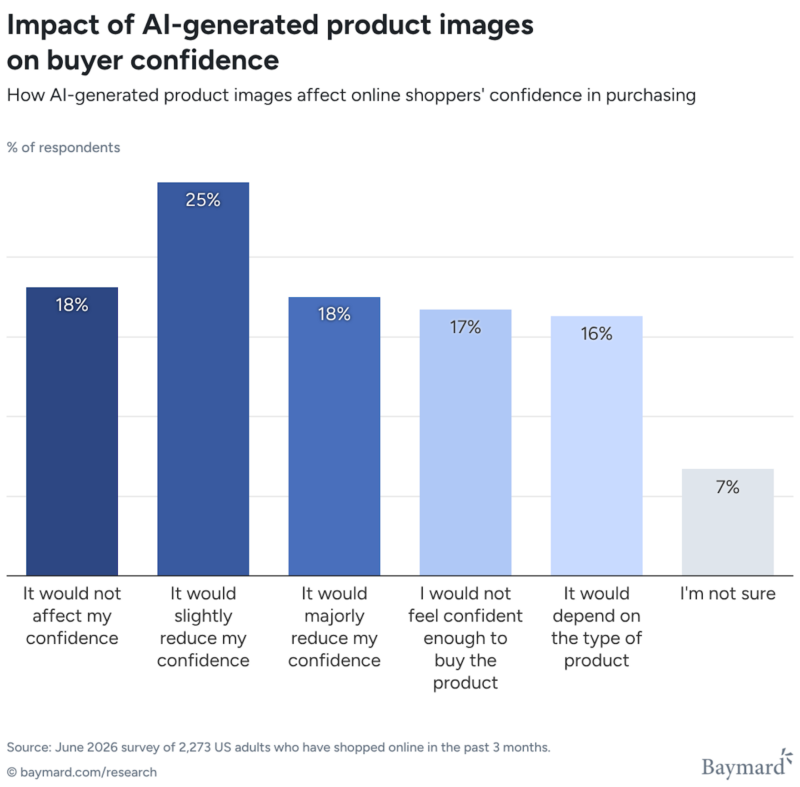
The study, conducted in June 2026, included 2,273 American online shoppers. 60% of respondents said that knowing how the images were created would make them less confident about buying. For 25%, the effect would be minor, while for 18% it would be significant. Another 17% said they would not feel confident enough to buy the product in that case. Only 18% said that a disclosure about AI use would not change how they felt about the purchase.
How Generative Graphics Affect Product Perception
Retailers are increasingly using generative AI to create product images, including lifestyle scenes, virtual models, and other marketing materials. This approach often helps reduce photography costs.
However, according to Baymard co-founder Christian Holst, product photos are more than just decoration for shoppers. They help people assess what will arrive after they place an order: the product’s color, fit, texture, and size. An AI-generated image can undermine trust in this information; for about one in six survey participants, that would be enough to abandon a purchase.
Holst believes generative images can have a place in product presentations, but the main photos should show the product accurately. AI-generated backgrounds and lifestyle scenes can be used as supplementary materials, as long as the brand does not undermine shopper trust.
Examples of Poor AI Use
In October 2026, food delivery service Just Eat apologized for several inaccurate AI-generated food images. One showed bacon and eggs floating in a soft drink.
Meanwhile, photo studios are closing across the fashion industry as brands increasingly turn to generative tools in the hope of making significant savings.
Recommendations for Online Stores
Baymard advises companies to use authentic photos as the main product images and reserve AI-generated visuals for supplementary content. Retailers should also be aware that audiences may be skeptical and address that concern directly whenever a product listing uses generated materials.
The full study results and charts are published on the Baymard website.