Sigma FP2: A compact full-frame camera with 6K video
Sigma FP2 review: a compact full-frame camera with a tilting screen, AI autofocus, 6K video recording, and ProRes RAW support.


The Sigma FP2 combines a 24.5MP sensor, a tilting screen, AI autofocus, and a modular body. The camera shoots 6K Open Gate at up to 60 fps; sales start November 11, with prices starting at $2,199.
Sigma FP2: A compact full-frame camera with a tilting screen and 6K recording
Since the Sigma fp launched in 2019, the camera market has changed considerably. At the time, it was introduced as the world’s smallest full-frame mirrorless camera. The new Sigma FP2 retains the compact body and resolution of around 24MP, but adds a faster sensor, an updated autofocus system, and expanded video recording capabilities.

“The Sigma FP2 is a direct reflection of our unwavering commitment to optical excellence and our pursuit of meaningful engineering innovation,” said Mark Amir-Hamzeh, president of Sigma Corporation of America. He said the company had taken into account the needs of creators working in vlogging, podcasting, photography, and cinema, and had created a hybrid camera with no significant compromises when shooting and publishing content across different platforms.
Modular design and controls
The FP2 retains the distinctive rectangular body of its predecessor. The L-Mount takes up almost the entire height of the front panel, leaving little room on either side. The camera measures approximately 112.8 × 69.9 × 41.8 mm and weighs 460 g with a battery and SD card installed.

The button layout on the rear largely echoes the fp, though Sigma has removed the Tone button below the screen. The top panel follows the same layout as before: the camera has two control dials and no traditional rear dial.
The biggest ergonomic change is the screen. The fp had a fixed display, while the FP2’s tilts up and down. It measures 3.15 inches diagonally and has a resolution of around 2.1 million dots. Tilting the display exposes ventilation fins on the rear panel to help dissipate heat during video recording.

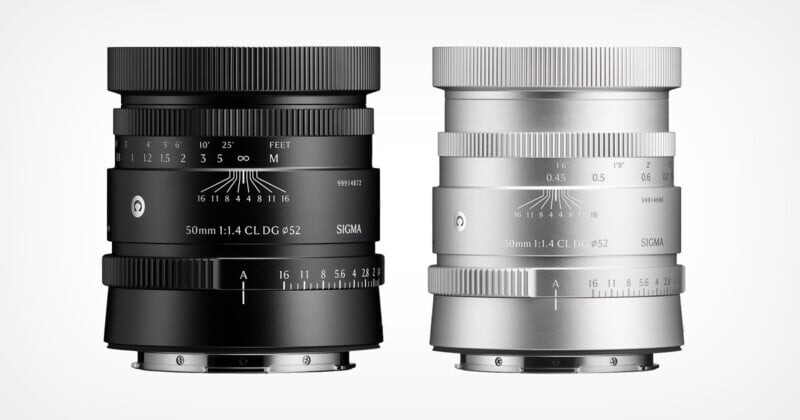
The exterior has also changed. Instead of the leather-like finish used on the original fp, the rear of the body and a small area on the front now feature a diamond-pattern texture. Sigma has also introduced new branding and a new typeface. The camera is shown, among other things, with the Sigma 50mm f/2 DG DN Contemporary lens.
The camera offers a wide range of connections for photo and video work: two USB-C ports, one of which supports USB 3.2, a full-size HDMI Type A port, and a timecode port that can also be used to connect an external microphone. 1/4-20-inch threaded mounting holes are located on three sides of the body, including the bottom.
Modularity remains one of the key design principles. Sigma describes the FP2 as a camera that can be used in a minimalist setup—a small body with vintage optics for street photography—or turned into a production rig with cine lenses, a matte box, and wireless monitors.
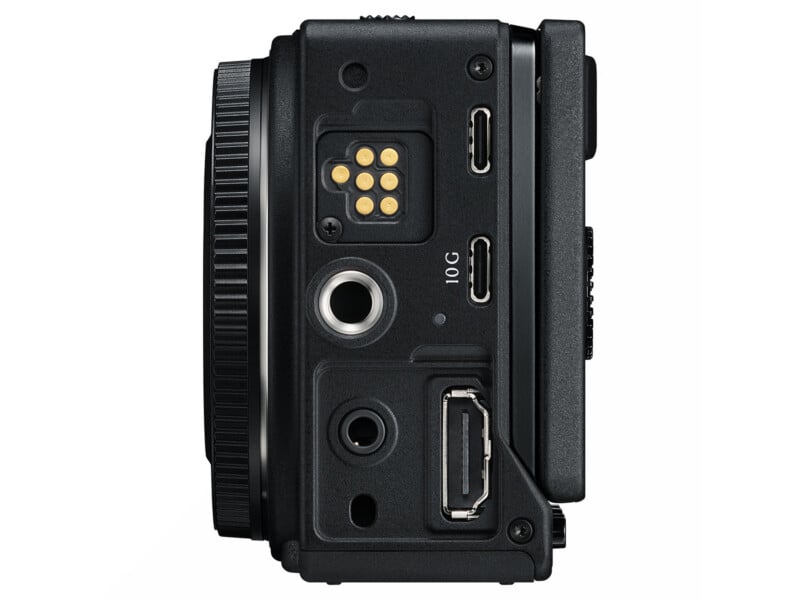
The EVF-21 electronic viewfinder is available separately. It features a 5.76-million-dot OLED display with 0.88× magnification and can tilt up to 90 degrees. It connects to the side USB port rather than a hot shoe: like the fp, the FP2 has no built-in shoe. If needed, one can be added using the optional HU-21 Hot Shoe Unit.
The body also lacks in-body image stabilization. It was likely not possible to fit IBIS into such a compact camera.

New sensor and still photography
The FP2 has no mechanical shutter and, like its predecessor, shoots only with an electronic shutter. The sensor has been updated, however: instead of the common 24MP BSI-CMOS sensor, it uses a 24.5MP full-frame partially stacked CMOS sensor.

Its specifications are reminiscent of the sensors in the Panasonic S5 II(X) and Nikon Z6 III. It is not possible to confirm whether the FP2 uses the exact same sensor, though that seems likely. The partially stacked design enables faster readout than the original fp, which should reduce rolling shutter—a benefit for both photography and, especially, video.
The ISO range is 100–102,400 for both stills and video. For still photography, sensitivity can be extended down to ISO 6. The electronic shutter speed ranges from 30 seconds to 1/25,600 second, and a Bulb mode of up to five minutes is also available. The maximum flash sync speed without a crop is 1/50 second. An optional HU-21 is required to use a hot shoe.
The camera features Sigma’s latest hybrid autofocus system with AI-powered subject tracking. It recognizes people, dogs, cats, and birds, and supports Eye AF for people. The maximum continuous shooting speed is 20 fps in JPEG and RAW (DNG). At full speed, the buffer can hold up to 180 DNG frames.

Built-in color modes include Rich, Warm Gold, Teal & Orange, and Sunset Red, among other options.
Video capabilities and battery life
Sigma positions the FP2 as a hybrid camera designed for both stills and video. It records 6K Open Gate video at up to 60 fps. In 4K, it can shoot at up to 60 fps across the full width of the frame and at up to 120 fps with a crop. Log video recording is also available.

The FP2 supports ProRes RAW HQ and ProRes RAW formats, recording video at up to 4K at 48 fps and up to 6K at 29.97 fps. When using the HU-21 unit, the camera also supports 32-bit float audio recording.
The camera has 70GB of built-in storage, along with a slot for UHS-II SD cards. The new battery retains the form factor of the original fp’s battery, but Sigma says it provides around 30% longer battery life. The claimed battery life is up to 370 shots or 130 minutes of video recording.

Price and availability
The Sigma FP2 goes on sale November 11. The body-only version will cost $2,199, while the kit with the EVF-21 electronic viewfinder will cost $2,749.