Bertie Gregory’s Seven Years Among Arctic Wolves
Bertie Gregory spent seven years observing Arctic wolves and made a National Geographic film about their lives and a rare moose hunt.


In a National Geographic film, Bertie Gregory returns to a pack of wolves in Hudson Bay after seven years of observation. The footage reveals the harsh reality of Arctic life, a rare moose hunt, and the filmmaker’s connection with the animals.
Wolves, the Arctic, and seven years of observation: Bertie Gregory’s new film for National Geographic
In the documentary special “Wolves Up Close With Bertie Gregory,” British wildlife filmmaker, photographer, and conservationist Bertie Gregory travels to Canada’s Hudson Bay. There, he films wolves in harsh Arctic conditions and returns to a pack he has been observing for seven years.

The film focuses on this particular group of animals, but also features other inhabitants of the region. Polar bears, red foxes, and moose appear on camera. Some encounters happen at close range: in one scene, a pair of polar bears comes so close to Gregory and the small film crew that the moment feels tense.
The unpredictability of filming and the work of guides
Gregory notes that a film crew can plan a scene in advance, but wild animals do not follow a script. Nature, he says, can upend the original plan on the very first day—making the work both more difficult and unpredictable.

Even so, he does not consider wolves the main source of danger. They also approached the group to check out the people, but Gregory was not concerned. The situation is different with polar bears and moose: these animals can be dangerous. However, he stresses that statistically, people pose a far greater threat than a bear or a moose. For safety, it is important to notice and correctly interpret animals’ body language.

On the expedition, Gregory worked with local guides Mike Rimer and Albert “Butch” Saunders. He says their contribution was key to the safety of the entire group. Saunders is an elder of the Swampy Cree people and an expert guide; Rimer also served as an experienced guide. The film crew included sound recordist Parker Brown, who, like the others, had to protect himself from the cold.
Gregory says he was cold throughout the entire episode. Arctic weather was a constant presence during filming, so the cold may have occupied his thoughts as much as the potential danger from the animals.

A connection with the wolf pack
Over seven years of observation, Gregory grew emotionally close to the wolves. Traditional documentary filmmaking often expects camera operators to remain completely detached, but he does not believe affection for animals is something to be suppressed. In his view, it is impossible to follow one pack for seven years—essentially an animal family—without beginning to care about them. Anyone who feels nothing at all strikes him as strange.
Gregory does not deliberately try to establish a connection: he understands that the relationship will never be mutual and that the wolves are not concerned about the people’s presence. But he cares about them. When filming animals, the director explains, there are two main approaches: to stay hidden so the animals do not notice people, or to let them get used to the group’s presence. In this pack’s case, the wolves know people are nearby and accept them; in a sense, they see the film crew as part of the surrounding landscape.

Gregory says that how filmmakers feel about their subjects is reflected in the final result. He compares it to something handmade or a drawing a child gives to their parents: when love comes through in the work, it gains an elusive quality that shapes how people respond to it. A wildlife documentary made with genuine care and admiration takes on a special expressiveness. Gregory believes there is no need to emphasize this deliberately—the feeling comes through on its own.
He is particularly interested in the contrast between domestic dogs and their wild relatives. Many people love dogs as family members, welcome them into their homes, and let them sleep in their beds, while treating wolves with excessive fear and often cruelty. Gregory considers this disparity unfair.

He also points to possible changes to the legal status of wolves in the United States. Federal authorities are considering removing gray wolves and Mexican wolves from the list of species protected under the Endangered Species Act. If the decision is made, the animals could lose the protections that helped their numbers recover in the country. Gregory urges people who care about wolves to contact politicians and other influential figures and bring public attention to the issue. Wolves are important to the natural world, and, he says, how people treat them says a great deal about us, too.
Aerial footage of the hunt
One of the expedition’s most unusual moments was filming the pack pursuing a moose. The hunt was observed from a drone. Gregory realized he was witnessing a rare event that, as far as he knew, no one in the area had ever seen before. Mike Rimer, who had been tracking wolves for 30 years, also said on camera that he had never seen anything like it.

The scene brought together traditional knowledge from local experts and modern technology. Gregory calls it a successful blend of old and new approaches: the experience of people who had watched the animals for decades was enhanced by the capabilities of a drone.
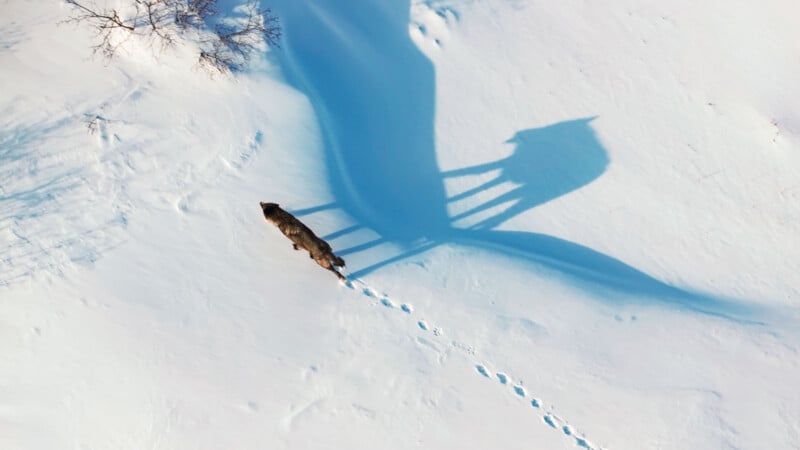
A wolf named Kona made the moment especially significant. Butch Saunders gave him his name; over the years of observation, Gregory watched Kona grow up and gradually become the pack leader. During the hunt, Kona was the one who tried to bring the moose down by grabbing one of its hind legs. At first, Gregory thought the story was so unbelievable that viewers would not buy it. Then he wondered whether Kona could withstand the strain and survive the encounter. The scene, he says, showed just how strong wolves can be.
Kona survived. The film also includes a quieter moment: Gregory looks at the now-aging wolf and reflects on his age. Life in the Arctic is hard, and the long, harsh winters pass quickly. Kona may not have many winters left, especially as the pack’s leader. But in this story, he briefly appears in all his power as an apex predator.

The visuals include footage of Gregory in Hudson Bay, the crew working in the snow, and scenes of guide Rimer, Swampy Cree elder Saunders, and the host together. The film features a wolf approaching to investigate the film crew, a close-up of a wolf’s eye, and a shot of a lone black wolf with its shadow. It also shows the pack howling, a paw print beside Gregory’s hand, wolves walking in single file through the snow and approaching a moose, and the animals feeding on their prey. In one shot, Kona holds onto the moose’s leg while the other wolves stay nearby.
“Wolves Up Close With Bertie Gregory” premieres November 6 on National Geographic. The film will be available on Hulu and Disney+ the following day. The filming photos are provided by National Geographic; the behind-the-scenes shots were taken by Rick Smith for National Geographic, and the wolf footage by Bertie Gregory for National Geographic.