The Cat's Head: Star Birth Through Hubble and Webb's Eyes
Hubble and James Webb revealed the Cat's Head Nebula, uncovering details of star birth in visible and infrared wavelengths.

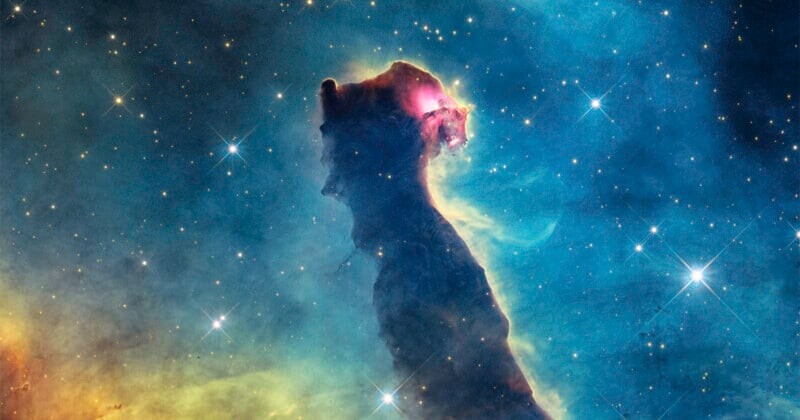
Hubble and Webb revealed different details of the Cat's Head Nebula in the Carina Nebula: a dusty silhouette and the complex structures within it. Radiation and stellar winds are gradually destroying the gas and dust.
The Cat's Head Nebula: How Hubble and Webb Revealed a Cosmic Silhouette
The Hubble and James Webb space telescopes combined their observations to capture the Cat's Head Nebula, a star-forming region resembling a ghostly feline silhouette. NASA describes it as a dynamic scene of star birth, like a figure emerging from a cold mist.

The nebula is located in the constellation Carina, within the Carina Nebula, about 7,500 light-years from Earth. This region is a frequent target for Webb and other space telescopes. It got its name from its shape, which resembles a cat sitting with its back to the viewer and its head turned to the right. A glowing eye is also visible in the images.
The image captured by the James Webb Space Telescope's NIRCam shows NGC 3372, HH 903, and the Cat's Head Nebula in the Carina Nebula. Image processing by Joseph DePasquale of STScI. Credits: NASA, ESA, CSA, STScI.

The cat's-head shape likely formed under the influence of powerful ultraviolet radiation and streams of stellar wind from massive stars in the Carina Nebula. These processes are gradually destroying the surrounding gas and dust. Denser material inside the pillar, whose outline resembles a cat, is still resisting erosion.
Over time, the nebula will disperse, and the growing stars will transform the surrounding region. For now, it remains an important site for studying star formation.

Different Wavelengths, Different Details
Hubble and Webb have different capabilities. Hubble's visible-light image shows the opaque cosmic dust that forms the body of the feline figure. The image was captured with the Wide Field Camera 3. Credits: NASA, ESA, STScI; processing by Joseph DePasquale of STScI.

Thanks to its near- and mid-infrared observations, Webb can see through interstellar dust. In the mid-infrared image captured by the MIRI instrument, warm dust and carbon-based molecules, energized by starlight, trace complex structures inside the nebula. Variations in local conditions and material composition create differences in color and brightness. Thin filaments and small, dense formations are especially visible to the left of the main pillar.
MIRI image credits: NASA, ESA, CSA, STScI; processing by Joseph DePasquale of STScI.