Metalenz acquires PxE Imaging for cameras that capture color and depth
Metalenz has acquired PxE Imaging and its Holocoder technology, which captures more light as well as color and depth without a Bayer filter.


Holocoder technology replaces the Bayer filter, lets 2.5 times more light reach the sensor, and captures color and depth simultaneously. Metalenz expects to bring it to market by the end of next year.
Metalenz acquires PxE Imaging: a new approach to color and image depth
On November 11, 2026, Metalenz announced its acquisition of Israeli startup PxE Imaging. PxE’s flagship technology, Holocoder, could replace the Bayer color filter used in traditional digital cameras.
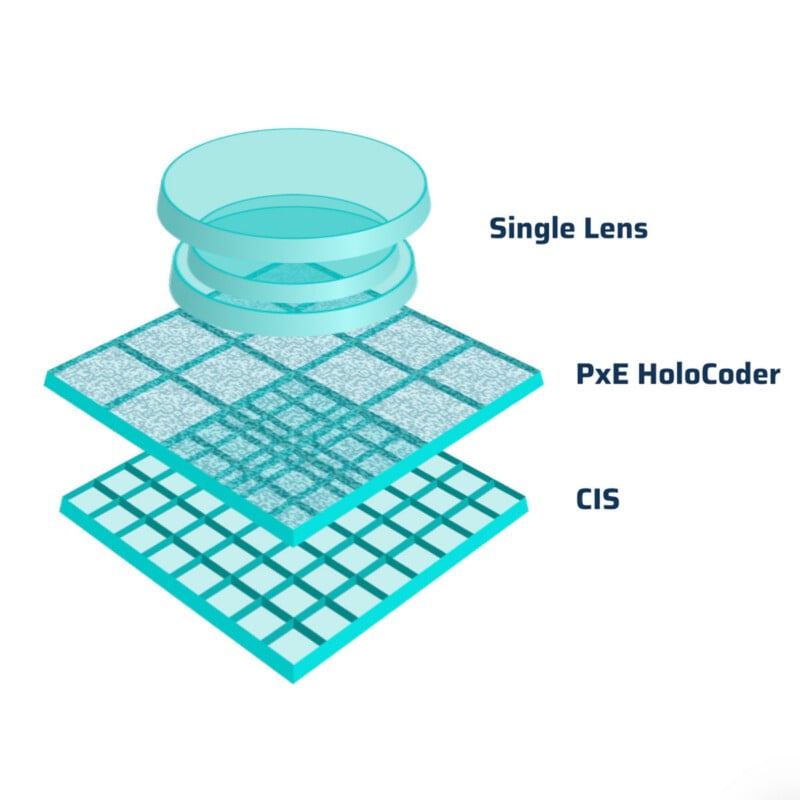
According to Metalenz, Holocoder eliminates the Bayer filter and separates light waves without absorbing them. As a result, 2.5 times more light reaches a standard sensor. All else being equal, the increased light reaching the sensor should improve camera performance and image quality in both dark scenes and bright conditions.
The Bayer filter enables conventional digital sensors to capture and reconstruct color, but Metalenz estimates that it absorbs about 60% of the light reaching the sensor. The HoloCoder layer, by contrast, is mounted directly on the sensor and directs rather than absorbs light, improving system efficiency.
From metasurfaces to computational vision
Like PxE Imaging, Metalenz develops technologies that are placed directly on the image sensor. A few years ago, Metalenz brought metasurface-based optics to market: extremely thin optical elements that can be printed using a process similar to semiconductor wafer manufacturing. In this design, the way the thin lens bends light plays a key role.

Holocoder also uses the properties of light, but to process information. The technology harnesses the wave nature of light to physically distinguish characteristics such as wavelength and depth. This allows a single camera to capture color and depth information simultaneously in a single image.
Following the deal, Metalenz will be able to supplement the data about materials and surfaces already collected by its products with detailed color and depth information. The company expects to do so without significantly complicating manufacturing or increasing computational demands.
“Metalenz is steadily expanding its intellectual property, from unique hardware to comprehensive solutions developed in conjunction with our metasurfaces,” said Metalenz co-founder and CEO Rob Devlin.
He said the company’s technologies are already being used in devices with particularly demanding component requirements. Metalenz has built a supply chain designed for mass production, as well as a software stack that carries sensor data all the way through to AI decision-making. PxE’s technology and team, Devlin noted, will enable the company to expand its capabilities in the visible spectrum, improve low-light imaging, and address the challenge of physical AI by capturing richer data than an ordinary RGB image.
“The real advantage in creating differentiated AI models comes from proprietary hardware capable of delivering new information to sensors. By combining our capabilities with PxE’s, we’ll extend this principle to all of machine vision, so people and machines can see and understand more of the world around them without relying on heavy computation,” Devlin added.
PxE Imaging co-founder and CEO Yoav Berlatsky explained that Holocoder was designed to extract information from light that conventional sensors discard or cannot capture. He said this increases a camera’s light sensitivity and enables it to capture color and depth simultaneously.
Berlatsky believes that joining Metalenz will give PxE the manufacturing platform and commercial reach needed to bring the technology to everyday devices. Their collaboration, he added, could give people higher-quality images and machines a fuller understanding of the world around them.
Challenges and rollout timeline
The terms of the deal have not been disclosed. Metalenz cannot currently combine Holocoder directly with its commercial metasurface optics, but sees such integration as a possibility for the future. Thanks to Metalenz’s manufacturing capabilities, PxE’s technology could reach the market as early as the end of next year.
In an interview with WIRED, Devlin noted that Apple, Samsung, and Google compete every year to improve their visible-spectrum cameras. According to him, these companies invest hundreds of millions of dollars in software in the hope of improving image quality. But if a sensor loses information because light is absorbed, software cannot bring it back—not even with the most extensive computing resources.
One possible application for the technology is autonomous vehicles, where compact cameras are important. In such systems, reducing camera size while increasing the amount of light reaching the sensor could be especially useful.
Smartphone cameras are another obvious application. As Devlin emphasized, sensors of any size face a physical challenge: capturing more and better data about light. The more light reaches the sensor, the better. The Bayer filter was a significant technological achievement, but its design has been around for a long time. PxE offers an alternative way to work with color information by processing light without absorbing it.